Fairmount City has faced plenty of supervillains before. But this may be its first livestreaming supervillain.
After losing her brief burst of social-media stardom, Hailey re-emerges with a new look, a new name, and a dangerous new relationship with engagement metrics. Now she is Countess Influencia — the Validation Vampire — and every heart, like, and notification seems to make her stronger.
Fairmount News Network tries to cover the attack, but even the news crew can’t stop checking her feed. As hearts start streaming from phones across the city — and around the world — it becomes clear that this crime spree is no longer just a local story.
The world has met Countess Influencia.
And she would very much like you to smash that “Like” button.
Transcript
Panel 1
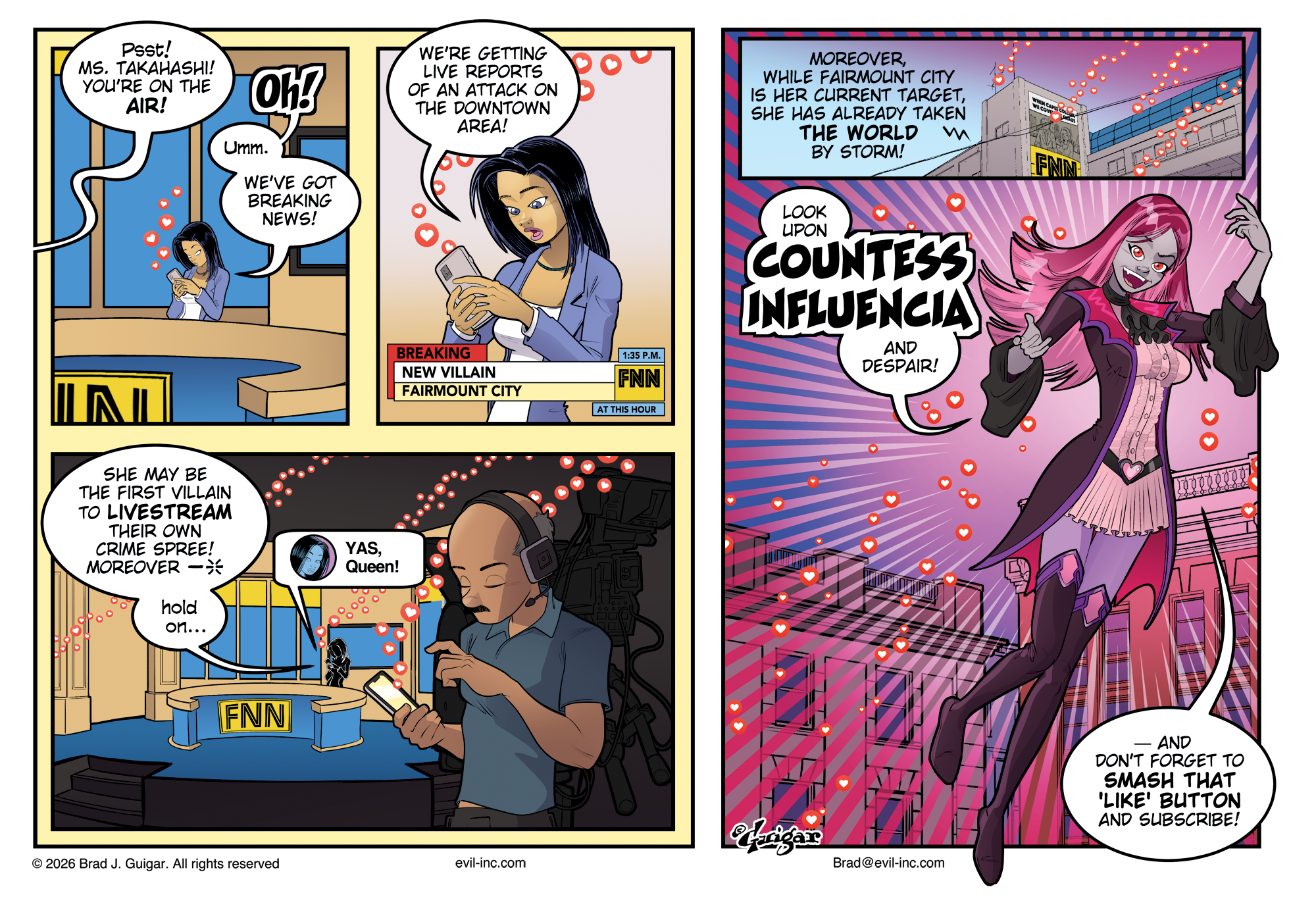
At the Fairmount News Network studio. Someone off panel whispers, “Psst! Ms. Takahaski! You’re on the air!” Hana Takahaski looks up from her smartphone and says, “Oh! Umm… We’ve got breaking news!”
Panel 2
Hana says, “We’re getting live reports of an attack on the downtown area.” A stream of hearts begins floating from her phone.
Panel 3
The scene widens. Hana is still on her phone. The cameraman is also on his phone. Streams of hearts flow from both phones and from other unseen people in the studio. Hana says, “She may be the first supervillain to livestream her own crime spree! Moreover…” Then, distracted by her phone, she says, “Hold on…” Her phone displays the text: “YAS, Queen!”
Panel 4 (inset)
Exterior view of the Fairmount News Network building. Several streams of hearts flow outward from inside the building and from the street below. Hana says, “Moreover, while Fairmount City is her current target, she has already taken the whole WORLD by storm!”
Panel 5
Hailey, now transformed into Countess Influencia, floats above the city as streams of hearts flow directly into her body. She says, “Look upon Countess Influencia and despair!” Then, in smaller type: “And don’t forget to smash that ‘Like’ button and subscribe!”
Alt text
A five-panel Evil Inc comic introduces Hailey’s new supervillain persona, Countess Influencia. At Fairmount News Network, anchor Hana Takahaski is caught looking at her phone just as she goes on the air with breaking news about an attack downtown. As she reports, red heart icons begin floating from her phone. The scene widens to show the cameraman and others in the studio also absorbed by their phones, with streams of hearts flowing upward. Hana reports that the villain may be the first supervillain to livestream her own crime spree, then gets distracted by a message reading, “YAS, Queen!” Outside the Fairmount News Network building, heart streams pour from the building and the street below. In the final panel, Hailey floats above the city in her new vampire-inspired outfit as Countess Influencia. Streams of hearts flow into her body as she declares, “Look upon Countess Influencia and despair!” She adds, “And don’t forget to smash that ‘Like’ button and subscribe!”

Wonder Woman creator William Moulton Marston
Remember when I
complained that a story about the history of Wonder Woman in the The
Philadelphia Daily News lacked any mention of the pervading themes of
bondage?Check out this fascinating piece by Charles Lyons, contributing writer for
ComicBookResources:
 She wasn’t jettisoned from a doomed planet, she didn’t witness the brutal murder of her parents, and she was never injected with radioactive venom, but the true story of Wonder Woman’s origin is one of the strangest and most fascinating of any superhero…
…Wonder Woman’s creator was William Moulton Marston, a Harvard-educated psychologist, lawyer and provocateur who invented a precursor of the modern polygraph (the likely inspiration for Wonder Woman’s lie-detecting lasso)…
As he told interviewer Olive Richard in the August 14, 1942 “Family Circle,” “Wonder Woman satisfies the subconscious, elaborately disguised desire of males to be mastered by a woman who loves them.”
But Marston was intent on more than merely fulfilling the fantasies of his male readers. In a letter to comics historian Coulton Waugh, he wrote, “Frankly, Wonder Woman is psychological propaganda for the new type of woman who should, I believe, rule the world.” Marston believed that submission to “loving authority” was the key to overcoming mankind’s violent urges, and that strong, self-realized women were the hope for a better future. Wonder Woman was very consciously Marston’s means of spreading these notions to impressionable young minds.
With this unusual brand of feminism as his stated aim, Marston filled his stories with bondage (both male and female), spanking, sorority initiation rituals, cross-dressing, infantilism, and playful domination. Armies of slave girls were everywhere, and hardly an issue went by without a full-body panel of Wonder Woman bound from head to toe. In “Sensation Comics” #35 (November 1944) Wonder Woman even lets slip that rope bondage was a popular pastime back home.Read more.The excerpts don’t do it justice. This is one engaging, well-written piece on a fascinating subject.