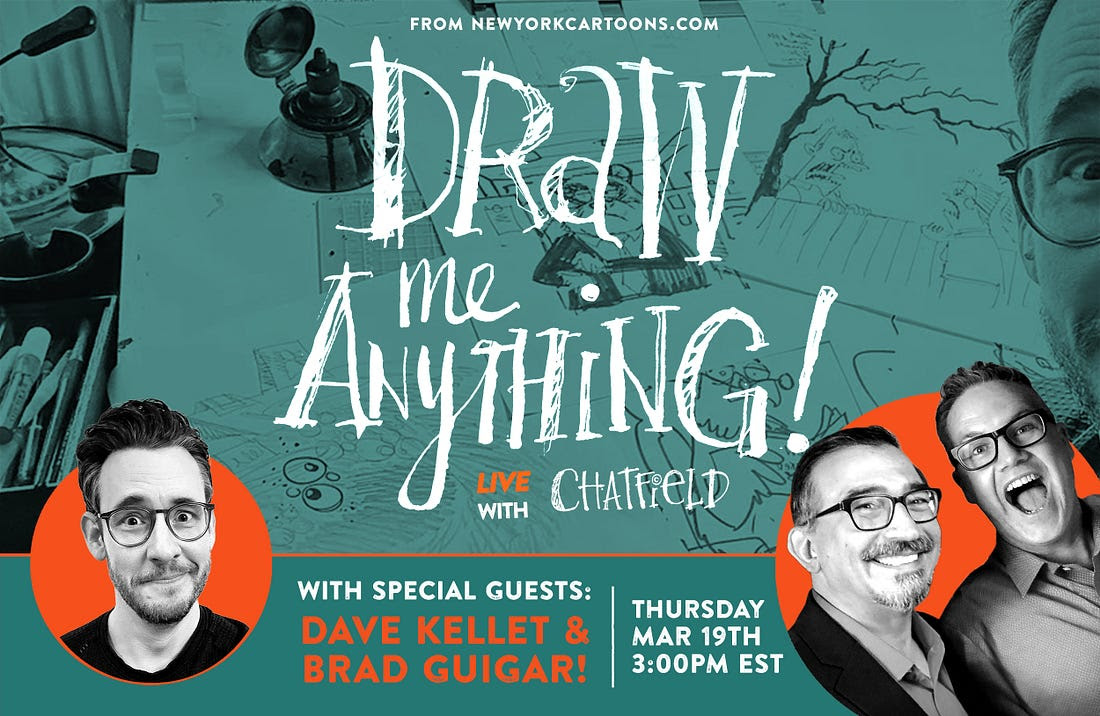
This is going to be so much fun! Dave Kellett and I will be Drawing Anything with our friend Jason Chatfield at 3 p.m. eastern time today. Join us!
https://open.substack.com/live-stream/139523?r=12wah&utm_medium=ios
In and Out of Trouble
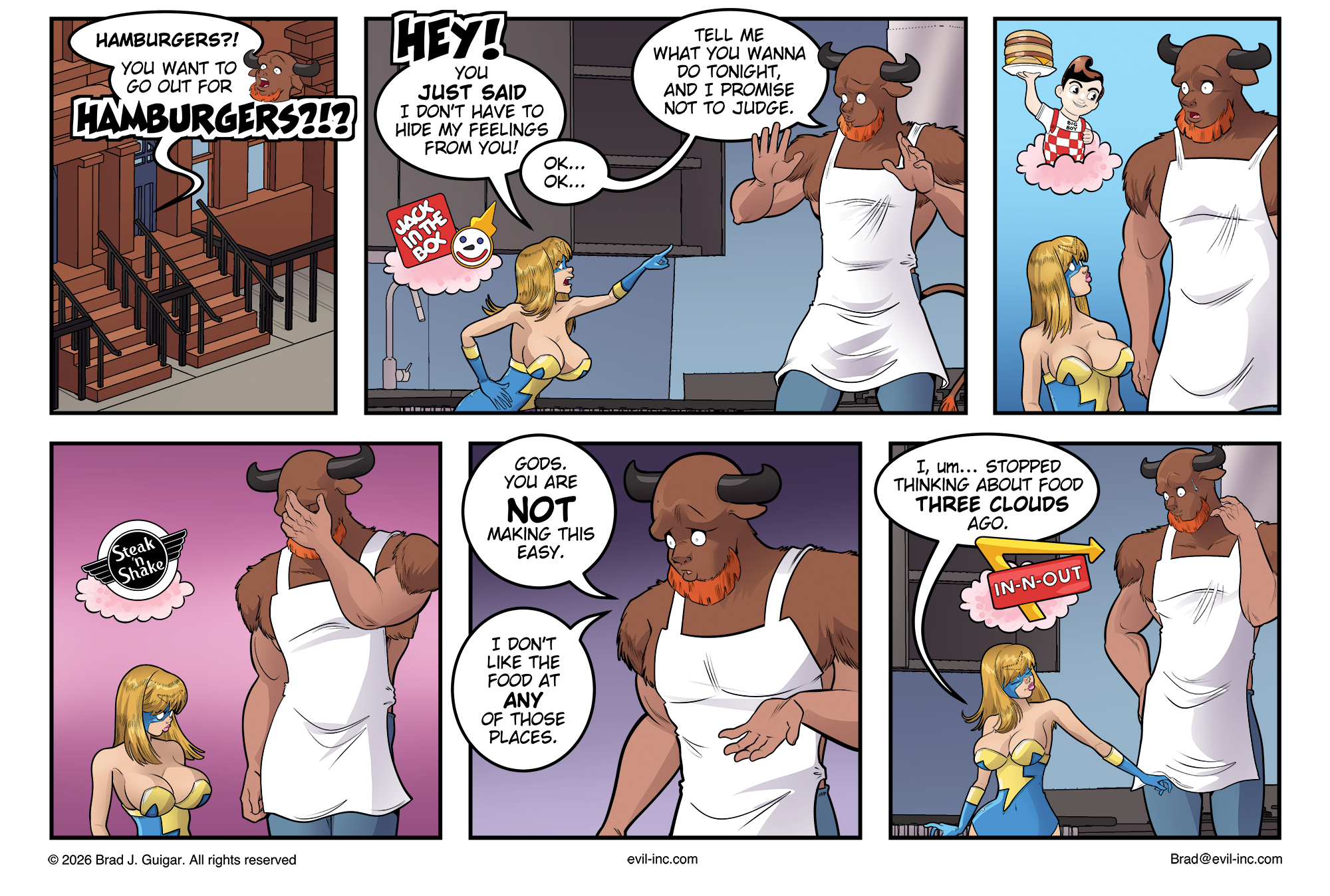
When Lightning Lady says she’s thinking about “In and Out,” she’s definitely not talking about burgers. Unfortunately, Angus the Minotaur is still stuck on the food angle — and it’s making for one very awkward (and unintentionally revealing) conversation about what she really wants tonight.
Transcript
Panel 1:
Angus (off-panel, shouting): “Hamburgers?! You want to go out for HAMBURGERS?!?”
Panel 2:
Lightning Lady: “HEY! You just said I don’t have to hide my feelings from you!”
Angus: “Tell me what you wanna do tonight, and I promise not to judge.”
Lightning Lady: “Ok… ok…”
Panel 3:
(Emotion bubble above Lightning Lady shows a Big Boy mascot holding burgers.)
Angus looks concerned.
Panel 4:
(Emotion bubble changes to a Steak ’n Shake logo.)
Angus facepalms.
Panel 5:
Angus: “Gods. You are NOT making this easy.”
Angus: “I don’t like the food at any of those places.”
Panel 6:
Lightning Lady: “I, um… stopped thinking about food three clouds ago.”
(Emotion bubble shows an In-N-Out sign.)
Angus is taken aback.
Alt Text
A six-panel comic featuring Lightning Lady, a blonde superhero in a blue-and-yellow costume, and her boyfriend Angus, a muscular minotaur wearing a white apron. Angus reacts loudly when she suggests hamburgers. She reminds him he said she could be honest, and he encourages her to share what she wants without judgment. As she hesitates, thought bubbles show fast food options like Jack in the Box, Steak ’n Shake, and In-N-Out. Angus grows increasingly stressed, facepalming and admitting he dislikes those places. In the final panel, Lightning Lady claims she stopped thinking about food while still gesturing, with a thought bubble indicating otherwise, as Angus is taken aback.
Marvel vs. DC
There was a great piece in Saturday’s
Washington Post about the old “Marvel vs. DC” debate.

There’s nothing much new there, but the writer, Hank Stuever, uses some absolutely fantastic imagrey. My personal favorite was “DC was about younger kids in back yards, wearing bath towel capes, leaping from treehouses. Marvel was about older kids in basements, possibly stoned, deconstructing Thor.”
[Washington Post]
Of the great brand-loyalty debates — Ford or Chevy? John or Paul? Road Runner or Coyote? Newport or Marlboro? Orthodox or Reform? — only a very few people still sort themselves along one of the narrowest consumer dichotomies of all:
Marvel or DC?
Back when it mattered, you used to be certain. You would ally yourself and endlessly argue the merits in comic-book stores or at a convention at the airport Ramada. DC Comics, led by Superman, was for people who adored the fantasy, the Ubermensch triumphant. These readers loved skyscrapers and archvillains and sidekicks, billowing flags, unerring ethical strength. Read more.
Dare I ask? Marvel or DC? I started as an absolute Marvel zombie when I first delved into comics in the 80s. When I returned to comics a few years ago as a thirty-something prodigal geek, I was stunned to realize DC titles outnumbering Marvel titles on my reserve list by a long margin.